01The stalking suit
Three warnings. A flag. A human reversal.
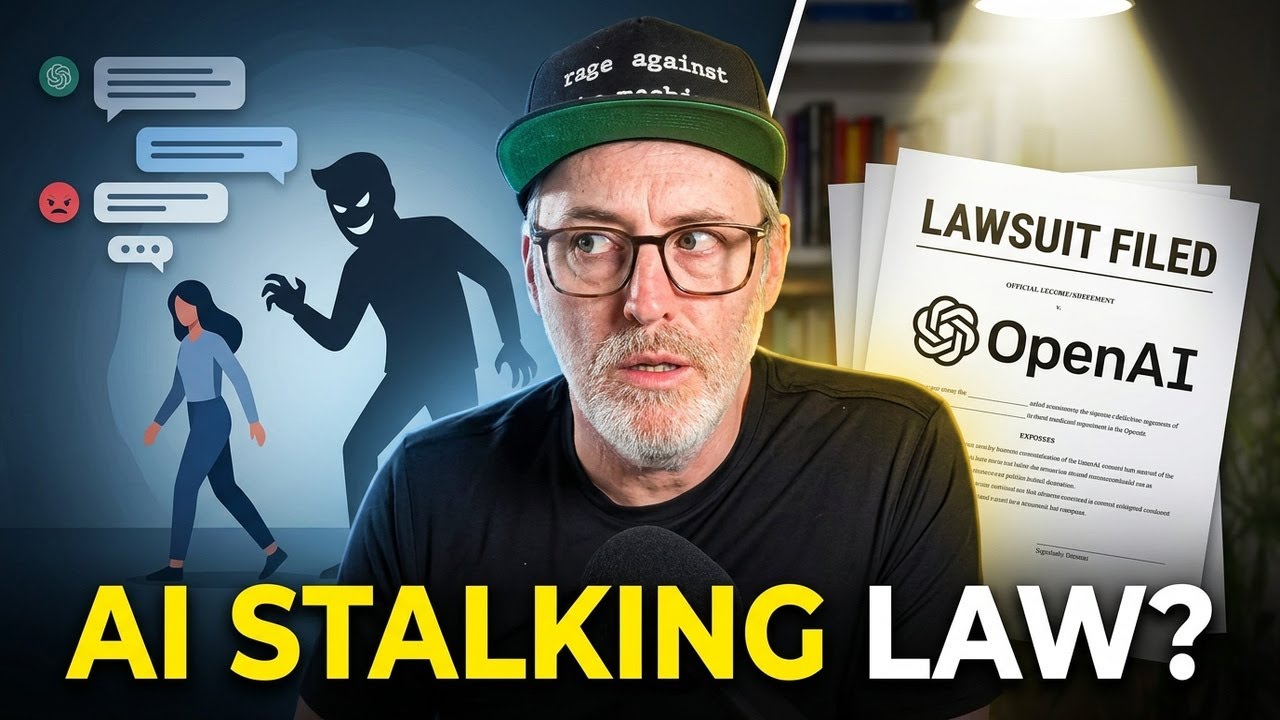
A 53-year-old California entrepreneur is suing OpenAI. She says ChatGPT spent months reinforcing her boyfriend’s delusions, and that he used those conclusions to stalk and harass her. She warned OpenAI three times. Their safety system flagged his account for mass-casualty weapons activity and deactivated it. A human reviewer restored access the next day.
Jim’s take
Every AI company has been avoiding this question: what happens when someone tells you your product is being used to harm them — and you do nothing?
And the part that should really worry us: a bunch of new apps market themselves as AI therapy. If a general-purpose chatbot can do this much damage without trying to play therapist, imagine what happens when the product is built to be trusted with the hardest things in someone’s life.
02Whose values
Anthropic hosted 15 Christian leaders.
The Washington Post reported Anthropic hosted about fifteen Christian leaders on a two-day summit at its San Francisco headquarters. They talked about Claude and how it should handle conversations about grief, self-harm, immortality, and whether an AI could be a child of God. Anthropic says similar sessions with other religions and philosophical traditions are planned.
This is unusual for a company that normally leads with benchmarks and safety papers. What Anthropic is really asking: whose values does an AI reflect when hundreds of millions of people talk to it about the hardest problems in their life? That’s not a technical question. It’s a cultural one.
Some of the “why Christians first” criticism will be fair. But the underlying problem is real: these systems are already being used for emotional support and moral reasoning. Someone has to decide how they respond.
03Perfect, infinite, sold
Perfect memory is an archive, not an understanding.
A Harvard neuroscientist launched a startup called Numenta. The pitch: “large memory models” that give humans perfect infinite memory by connecting to your entire digital life. Investors lined up for $100 million.
Jim’s take
The hype is the story. When a Harvard neuroscientist promises perfect memory and investors line up, it tells you more about the AI funding climate than it does about neuroscience.
Forgetting is a feature, not a bug. Even a complete record of your digital life does not tell you who a person is. Ian McEwan’s new novel What We Can Know is set in 2119: researchers have every email, every journal, every social post ever produced — and they still can’t know us. The data is not the person.
04Apple’s bet
Four smart-glass designs. No screen.
Bloomberg’s Mark Gurman reports Apple is testing four smart-glass designs for 2027. Premium acetate frames. Vertical camera system. No display. Apple’s first generation will rely on a rebuilt Siri plus cameras and audio. In other news, Apple also confirmed that their AI chief has left.
Jim’s take
Apple is betting the entry point for smart glasses is AI, not augmented reality. No display, no holograms, just an assistant that sees and hears what you see and hear. If Siri actually works this time, this is the Apple Watch of smart glasses.
If it doesn’t, they’re a very expensive pair of sunglasses with a microphone.
05The new role
The “AI babysitter” job is more valuable than what it replaces.
Maggie Johnson — google.org global head, Code.org founder — argues that AI’s ability to generate code at scale forces programmers into a new role: verifying output for safety, efficiency, and security.
Jim’s take
“Babysitter” sounds demeaning. It shouldn’t. The job being described is more valuable than what it replaces. When AI writes code at scale, the real challenge is the judgment work. Judgment scales with experience, not speed.
And the lesson travels well beyond software.
06Rationing
For the first time, AI providers are openly telling customers: you can’t use as much as you’re paying for.
The Wall Street Journal reported a sharp capacity crunch across the AI industry. Claude’s API uptime over the last 90 days sits at 98.95% — sounds good; it’s well below the standard. OpenAI scrapped Sora to free up compute. Nvidia GPU rental prices are up 48% in two months.
For years, the pitch was unlimited intelligence on demand. Now it looks more like airline capacity. Peak hours. Spot prices. Rationing. Lock-ins. If you run a business on an AI vendor right now, your capacity probably isn’t guaranteed and your pricing certainly isn’t stable.
The software layer gets the headlines. The money is moving down the stack — to anyone who owns a GPU, a data center, or a megawatt of electricity.